TEHNOMARKET d.o.o.
ALUMINIUM PROFILE EXTRUSION
COMPOSITE PANELS
- PRODUCTS
- EXTRUSION
- ALUBOND
- PROJECTS
- CAREER
- COMPANY
Aluminium
Aluminium is the most common metal on earth and it makes 8% of the Earth’s crust. Because of its exquisite properties, it is the second widest used metal after steel, with world production of 30 million tons annualy.
Widespread use of aluminium comes from unique combination of lightness, stiffness, longievity and anticorrosive properties combined with good thermal and electrical conductivity. Numerous aluminium alloys use these properties to their benefit.
Aluminium is ery easily machined to very fine tolerances. It can be extruded, welded, rolled both hot and cold from massive plates to thinnest foils only couple of microns thick. It also allows different surface treatments, where electrostatic pulerisation and anodizing are the most commom ones.
Aluminium is not flammable and it does not release toxic fumes even at high temperatures. It is also higly suitable for recycling, because only 5% of energy required for obtaining of primary aluminium is used in the proces.
Aluminium Trade
International aluminium trading is taking place at London Metal Exchange (LME), wich was founded in 1877. There are also several local stock markets like Shanghai Metal Exchange or American Market (AMM).
Manufacturers price of aluminium profilesis usually expressed in the orm LME+Premium wich translates to “Price on London Metal Exchange” + price for extrusion and fabrication.
Glass
Shorth history of glass manufacturing
Substances similar to glass exist in natural form and they are used from ancient times. Best known is obsidian, of vulcanic origin. First glass manufacture dates from ancient times. It is considered that travelling mediteranian traders have accidentaly mixed potass, sand and lime in the fireplace and that they have noticed hard, clear substance that has left whan the fire has died. These same basic substancer are also used today for glass manufacturing. The Egiptians have founded first known glass factory arrond 1400 BC. This technique was spread troughout Europe by Romans arround 500 AC.
Flt glass vas manufactured for centuries by blowing of large glass baloons at the end of metal pipe. After the ends vere cut off, it was layed on flat, heated stone plates to be ironed out by wooden rollers. By the mid 19th century this technique was so perfected that it was possible to manufacture glss cylinders with lengths up to 12 meters. As an alterative, the centrifugal casting of glass was developed, and this type of glass could be polished, wich brougt a significant advance in quality and optical properties at the beginning of 20th century. In 1959, the Pilkington brothers have patented process of FLOAT glass manufacturing in England. Even today, 90% of worlds glass production is being done with this technique.
What is LOW EMISSIVITY GLASS?
Low emissivity glass, commonly known as Low-E is a gass coated with thin Metallic film in order to improve thermal performance. Applied film reduces permability of heat rays without reduction in light permeability. Simply said, the Metallic film reflects the heat back at its source. It practically means that at sommer heat rays from the Sun do not enter the room, while during winter all heat from heating sources remains within the room. This method allows great energy savings, and makes dwelling in the room much more comfortable. It also helps to reduce the damaging UV-rays. It will have a beneficial effect on Your skin, and your drapes will never pale in the sun.
What is U-value (previously known as K-coefficient)?
The U-factor or U-value is a measure of Windows’s thermal efficiency, based on ressistance towards thermal energy flow. The lower the U-value is, the better the Thermal efficiency of the window. There are three major element for improvement of thermal performance of the window:
- Internal spacing between thermo-insulating glass sheets
- Usage of Low-E glass
- Usage of Argone gas for filling of space between glass sheets
Tehnomarket applies all three principals.
According to test certification results performed by Institute for material testing of Serbia, our windows have following U-values:
- System with thermal break ALUMINIK TMT56 U= 2,43 W/m2K
- System with thermal break ALUMINIK TMT64 U= 2,07 W/m2K
Why are thermo-insulating glass packages filled with Argon gas?
Today there are two main ways of filling of the space between the glass sheets. First, and most widely used in our region, is filling with filtrated air with addition of special moist absorbing granules. Second, far better and slightly costlier, is filling with Argon gas. Argon is a gas without color, smell or taste. It is inflammable, inert and it is not hazardous to health.
Debljina ovog sloja se kreće od 12 do 30 µ. Idealna debljina eloksaže je od 15 do 18 µ.
Thermal conductivity of argon is slightly lower than that of air wich improwe thermal balance to somewhat. It is important to know that Argon has poor thermal performance in the solar rays frequancy range ie. It has bad Solar factor, and is therefore efficient only when used together with Low-E glass.
Protection
Surface treatment
Anodisation is a electrochemical process wich adds a controlled layer of aluminium oxide in the form of vitrious cristall coat to the surface of aluminium profile.
Thickness of this coat is in the range from 12 to 30 µ, with ideal thickness being 15 to 18 µ.
Thinner layers are prome to mechanical wear, while the ones thicker than 25µ are to brittle and tend to break during the bending of profiles.
Colours for anodization range from natural colour of aluminium, trough bronze to black. It is also possible to anodize in golden colour but it is less durable. Trough some special processess it is possible to get blue, red or green color, but this is rarely used due to high costs involved. The colouring is done with non-organic pigments based on cobalt, mangane or rarely based on organic ones.
JUS strictly describes this type of surface treatment and certification can be done at the Institute for Research of Materials, Serbia.
Electrostatic Pulverisation or Powder Coating is mostly used type of surface treatment for aluminum alloys today.
The process is done in several phases.
First you have to de-grease aluminium surface with bathing in solution of sodium-hydroxide. After that the primer, usually chrome oxyd, is applied. During the next phase special diffusors apply strong positivelly charged colour powder. Considering that aluminium profiles ,wich are about to receive Powder Coating, are negativelly charged, a firm bonding between profile surface and colour powder occurs.
These profiles are then placed in an oven and heated between 180 and 200ºC.
As a result of heating, melting and polymerisation of color powder ocuurs, and forms a special coat, 50 to 70µ thick.
Epoxy based color is used in interiours, and more UV-resistent polyester based colors are used for exteriour use.
Liquid coating is alo gaining popularity, especially with high volume manufacturers due to lower costs involved.
Technically, it is virtually the same procedure, and only difference is that profiles are bathed in a pool of liquid colour, instead of more complicated usage of powdered colors.
Important remarks:
- Anodized aluminium is very resistant against acids, but very vulnerable to alkali. Therefore, it is extremelly important not to leave mortar or lime on the window surface longer that few minutes or irreperable damage to the coating will occur. There is no way to repair this type of damages..
- Powder Coating color is chosen from RAL color chart. Surface gloss is measured in GLOSS units and it ranges from 20 Gloss (matte surface) to high gloss (80 to 100 gloss units). Anodization color is chosen from manufacturers color chart, wich usually consists of 6 shades. Certain deviation of colour is allowed, and is tolerated up to a half-shade or less.
- European and American standards allow minor imperfections of Powdercoated or Anodized surface, wich means that these imperfections must not be visible from 3 meters when lookin perpendicularly at the surface.
- Damages in Anodized coating are very difficult to repair. In that sense, usage of Eloxal spray is recommended, but the results are usually not satisfying.
- Damaged Powder coat is relativelly easy to repair with special sprays or powder diluted in acetone.
Cleaning and maintenance of aluminium
Surface of anodized aluminium is best cleaned and preserved with following:
- Wash the door or window with liquid detergent for dishes, diluted in warm water.
- Wipe and leave to dry.
- Make a solution of 20% lineseed oil and 80% of medical grade alcohol.
Then do the following:
- Use soft cloth, well soaked with solution, and wipe all visible aluminium surfaces and rubber gaskets.
- After two hours polish with dry cloth.
Treated surfaces now have a thin protective film with very good anty-static properties, wich efficiently repels dust and other atmosferic dirts. You will be very satisfied with result.
Surface of Powder coated aluminium is best cleaned using following steps:
- Wash the door or window with liquid detergent for dishes, diluted in warm water.
- Wipe off and leave to dry.
- Apply silicone spray for leaning of car interiours (awailable at every car store and supermarkets).
- After 10 minutes polish with dry cloth.
NEVER:
- Clean Your doors and windows during very high or very low temperatures
- Do not lubricte window hardware. It is self lubricating, and additional oil will only collect dust and, in time, block the mechanism.
- Do not use sharp objects like knives, screwdrivers and such
- Do not use any paint thinner before consultation with qualified staff.
- Do not look for a needle in a haystack, because it exists and it may happen that You will find it. And what will You do than?
ALWAYS:
- Ask our technical support when You are not shure how to clean Your dooes and windows. Our phones +381 13 317293; 347053 and others are always available.
- 2. Be positive, love Your house and or apartment and people who live there. Your doors and windows will shine (from hapiness) and everyone will notice.
Bending of aluminium and steel profiles
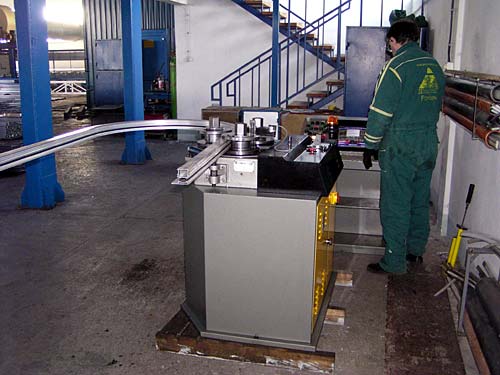
Tehnomarket was first company in former Yugoslavia that introduced CNC technology ie. Completelly computer-controlled process of bending of aluminium profiles, and today many of door and window manufacturers from the region use our services
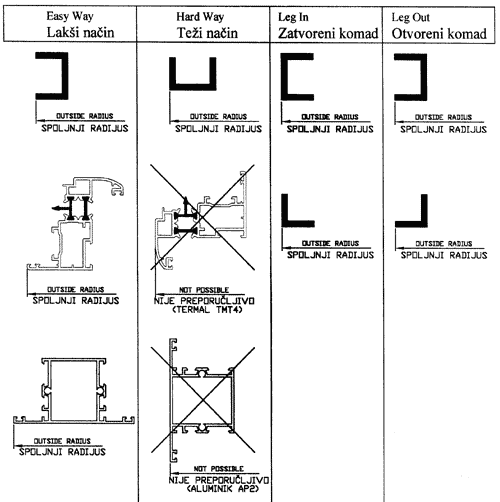
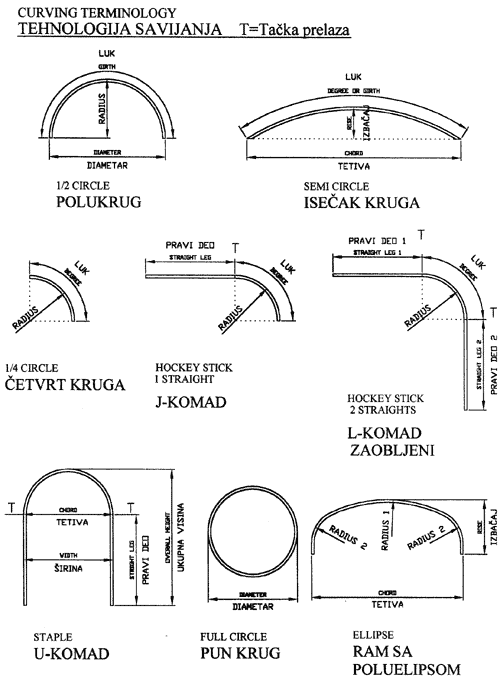
The process of bending of aluminium profiles is very complex,and it used o be almost impossible to make a high quality arched aluminium door or window, but today, the use of CNC bendng machinery ensures high quality and minimal tolerances, and enebles us to cater to our customers needs.
Products
Aluminium profiles
Subconstruction for granite
Doors and windows
Supplying of Fabricators
Services
Bending constructions
Assembly of thermal break
Machining of Alubond
Doors and Windows
Without thermal brake TM45
Without thermal brake TMH45
Thermal TMT56
Thermal TMT64
Alum-wood Convex TMD56
High thermal efficiency TMT79hi
Blindo TMB78